
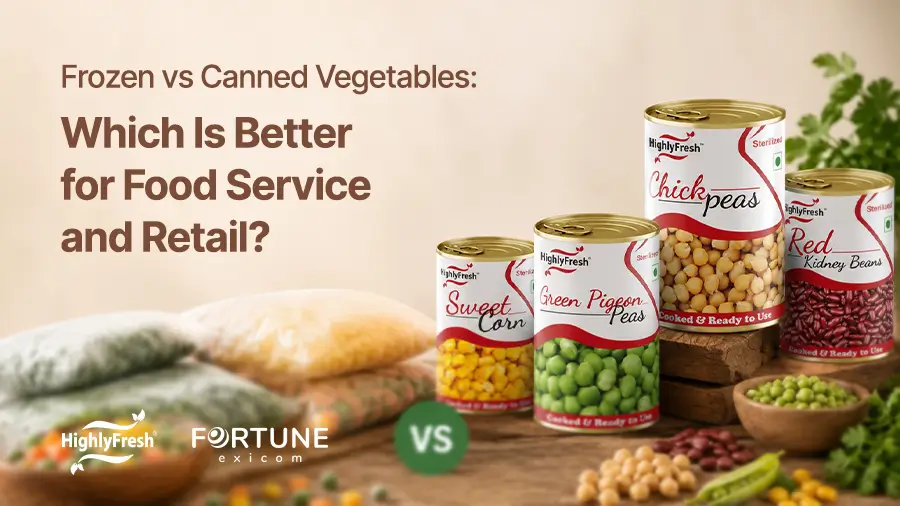
If you buy vegetables for a restaurant, supermarket, distributor, or food-service operation, you have probably compared frozen and canned options at some point. The answer is not simply that one is better than the other. A restaurant with plenty of freezer space may have very different requirements from a distributor working with ambient storage. Frozen vegetables are usually chosen for convenience, portion control, and texture. Canned vegetables are valued for easy storage, shelf life, and quick preparation. The right choice comes down to how you actually plan to use the product.
Frozen vs Canned Vegetables: What’s the Difference?
Frozen vegetables are normally cleaned, sorted, cut, blanched, and frozen before packing. Many commercial suppliers use IQF (Individual Quick Frozen) processing, which keeps the pieces separate rather than freezing them into one solid block.
That is useful in a busy kitchen. Staff can take out the amount needed for a particular dish and return the rest to the freezer.
Canned vegetables follow a different process. The prepared vegetables are packed into sealed containers and heat-processed. Once unopened, they can be stored at room temperature, so there is no need for freezer space. For a buyer, that simple difference can affect storage, transport, stock planning, preparation time, and overall cost.
Are Frozen Vegetables Healthier Than Canned?
Not necessarily. Frozen vegetables can retain nutrients well because they are often processed soon after harvesting. Canning uses heat treatment, which may reduce some heat-sensitive nutrients. However, the final nutritional value depends on the vegetable, processing method, recipe, and packing medium. There is no rule that says all frozen vegetables are nutritionally better than all canned vegetables. Check the actual product specification and nutrition information before making a decision. If nutrition is important for your product range, check the actual specification and nutrition information rather than choosing based on the format alone.
How Are Frozen Vegetables Processed?
Commercial frozen vegetables commonly go through cleaning, sorting, cutting, blanching, and freezing. IQF processing is particularly useful for food service because individual pieces remain separate. That gives the kitchen more control over how much product is used at a time.
Frozen vegetables can work particularly well when a business:
- Uses the same vegetable across several dishes
- Needs different quantities from one service to another
- Wants a consistent cut size
- Has enough freezer capacity
- Needs quick preparation during busy service
The main thing to plan for is storage. Frozen products need proper temperature control throughout transport and storage.
How Are Canned Vegetables Processed?
Canned vegetables are prepared, packed, sealed, and heat processed before being sent to market. The biggest practical advantage is storage. A distributor can keep cans in an ambient warehouse, and a restaurant can hold them in normal dry storage until they are needed. This makes canned vegetables useful for recipes where the vegetable is an ingredient rather than the main feature of the dish. Soups, sauces, curries, stews, fillings, and other high-volume preparations are common examples.
Frozen vs Canned Vegetables:
Here are quick comparison for Frozen vs Canned Vegetables
| Factor | Frozen | Canned |
|---|---|---|
| Storage | Freezer | Ambient before opening |
| Cold chain | Required | Generally not required before opening |
| Texture | Usually firmer | Usually softer |
| Portioning | Easy, especially with IQF | Less flexible after opening |
| Preparation | Quick | Very quick |
| Storage management | More demanding | Easier |
| Common advantage | Portion control and texture | Convenience and shelf stability |
Which Is Better for Restaurants and Food Service?
Look at what is happening in the kitchen. Frozen vegetables are often a good choice for dishes where texture and appearance matter. Stir-fries, rice dishes, pasta, side dishes, and mixed vegetables are examples where frozen products can be convenient. They also make sense when one product is used in several recipes. Instead of opening a full pack for every preparation, the kitchen can take what it needs.
Canned vegetables are useful in a different way. If the kitchen has limited freezer space or needs ingredients that can be stored easily, cans can be much simpler to manage. A restaurant does not necessarily have to choose one format. It may make sense to use frozen peas for one menu item and canned sweet corn for another.
What About Retailers and Distributors?
For retailers and distributors, the storage setup can make the decision fairly straightforward. Frozen vegetables need temperature-controlled transportation, freezer storage, and suitable freezer space in the retail outlet. Canned vegetables can be stored in ambient warehouses and displayed on regular grocery shelves. It also influences inventory planning, distribution requirements, and product pricing.
A distributor buying bulk frozen vegetables needs to account for cold storage and frozen transportation. A buyer dealing in wholesale canned vegetables may be more concerned with pallet space, carton weight, can size, shelf life, and stock rotation. So, don’t compare the two formats on product price alone.
When Should You Choose Frozen Vegetables?
Frozen vegetables are worth considering if your operation already has reliable freezer facilities and you need flexibility in daily use. If you are evaluating an IQF vegetable supplier, ask about the actual product rather than accepting a general catalogue description. Check the cut size, pack size, MOQ, storage requirements, samples, lead time, and whether the supplier can provide the same specification on repeat orders. For a restaurant or distributor, consistency can be more important than getting the lowest price on the first order.
When Are Canned Vegetables a Better Choice?
Canned vegetables make sense when easy storage and longer shelf stability are important. They can be especially convenient for businesses that do not have much freezer capacity or do not use a particular vegetable quickly enough to justify frozen storage. Before buying from a canned food supplier, look at the can size and, importantly, the drained weight. Also check the packing medium, shelf life, carton quantity, and product specification. Two cans with similar prices may not provide the same usable quantity, so this is worth checking before comparing quotations.
Don’t Forget the Total Cost
The supplier’s price is only one part of the calculation. For frozen vegetables, you may also be paying for frozen transport, freezer storage, electricity, handling, and potential product loss. For canned products, the costs may look different. Warehouse space, carton handling, pallet configuration, packaging, and usable yield can all affect the final cost. For B2B purchasing, it is better to compare the total landed and operating cost than simply choosing the lowest price per case.
What Should You Ask a Supplier Before Ordering?
Once you have decided which format suits your business, get the important details confirmed before placing the order. At a minimum, ask about:
- Product and grade specification
- Vegetable variety and cut
- Pack size
- MOQ
- Shelf life
- Storage conditions
- Samples
- Lead time
- Repeat availability
- Private-label packaging, if required
If you are buying regularly, also ask whether the supplier can maintain the same specification and packaging from one shipment to the next.
Fortune Exicom Frozen and Canned Vegetable Range
Fortune Exicom supplies frozen/IQF vegetables and canned food products for international B2B buyers, including restaurants, distributors, retailers, and food businesses. If you are comparing both formats, you can explore the canned product range and the wider Fortune Exicom product portfolio for available products, packaging options, samples, MOQ, and bulk enquiries. For businesses buying more than one category, working with a supplier that can handle both frozen and canned products may also simplify sourcing and communication.
FAQs
What is IQF frozen vegetables?
IQF (Individual Quick Frozen) vegetables are frozen individually at low temperatures, helping maintain separate pieces, consistent quality, and easier portion control.
Are frozen vegetables better than canned vegetables?
Not in every case. Frozen vegetables are a better choice for texture and portion control. While canned vegetables are convenient when storage and shelf stability are more important.
Which lasts longer, frozen or canned vegetables?
Canned vegetables generally have a longer unopened shelf life at ambient temperature. Frozen vegetables can also be stored for extended periods, but they must remain properly frozen.
Are frozen vegetables suitable for restaurants?
Yes. They are particularly useful when kitchens need consistent cuts, flexible portions, and quick preparation.
Why do restaurants use canned vegetables?
Canned vegetables are easy to store and ready to use, which makes them practical for soups, sauces, curries, stews, and other recipes prepared in larger quantities.
Do frozen vegetables need a cold chain?
Yes. Frozen vegetables need appropriate temperature control during transport, warehousing, and storage.
Can frozen and canned vegetables be purchased in bulk?
Yes. Both formats are available for wholesale and food-service purchasing. MOQ, pack sizes, availability, and storage requirements will depend on the supplier and product.
Which is better for food service: frozen or canned?
There is no single answer. Frozen usually has an advantage where texture and portion control matter. Canned is often easier where storage space and preparation time are the bigger concerns. Many food-service businesses use both.

